Tuesday, August 5, 2014

Miss a day, you miss a lot

When I was a teacher, there was a poster in school that said something like, "Miss a day, you miss a lot."  A perennial garden is kind of like that.  You go on vacation, and it's changed when you get back.  Every time we return from one of our camping trips, we walk around the gardens to see what's new.   Yesterday I posted pictures of plants that were blooming in June and July.  I walked around with my camera today to see what's new for August.


Morning glories


Snapdragons are one of my favorite flowers.  Although they are an annual, they seem like a perennial because they reseed so reliably.  I bought a flat many years ago and I have had them in my yard ever since.  Of course I can't say where they'll show up. Gardener's surprise!

Snapdragons come in lots of  different colors.


Sea holly
Sea holly is another favorite.  It also reseeds.  The stems are the same blueish-purple as the flower!

Balloon flower


Balloon flower is also a favorite (I guess they're ALL my favorite!)  Before the blooms open, they look like tiny balloons.


Most daylilies are finishing up, but there are late varieties that are just getting going.

Trumpet vine


Mallow (zebrina)
Potentilla
Astilbe
There two have been blooming for a long time - my kind of plants!

Okay, so it's not new in August, but the coneflower still looks great!

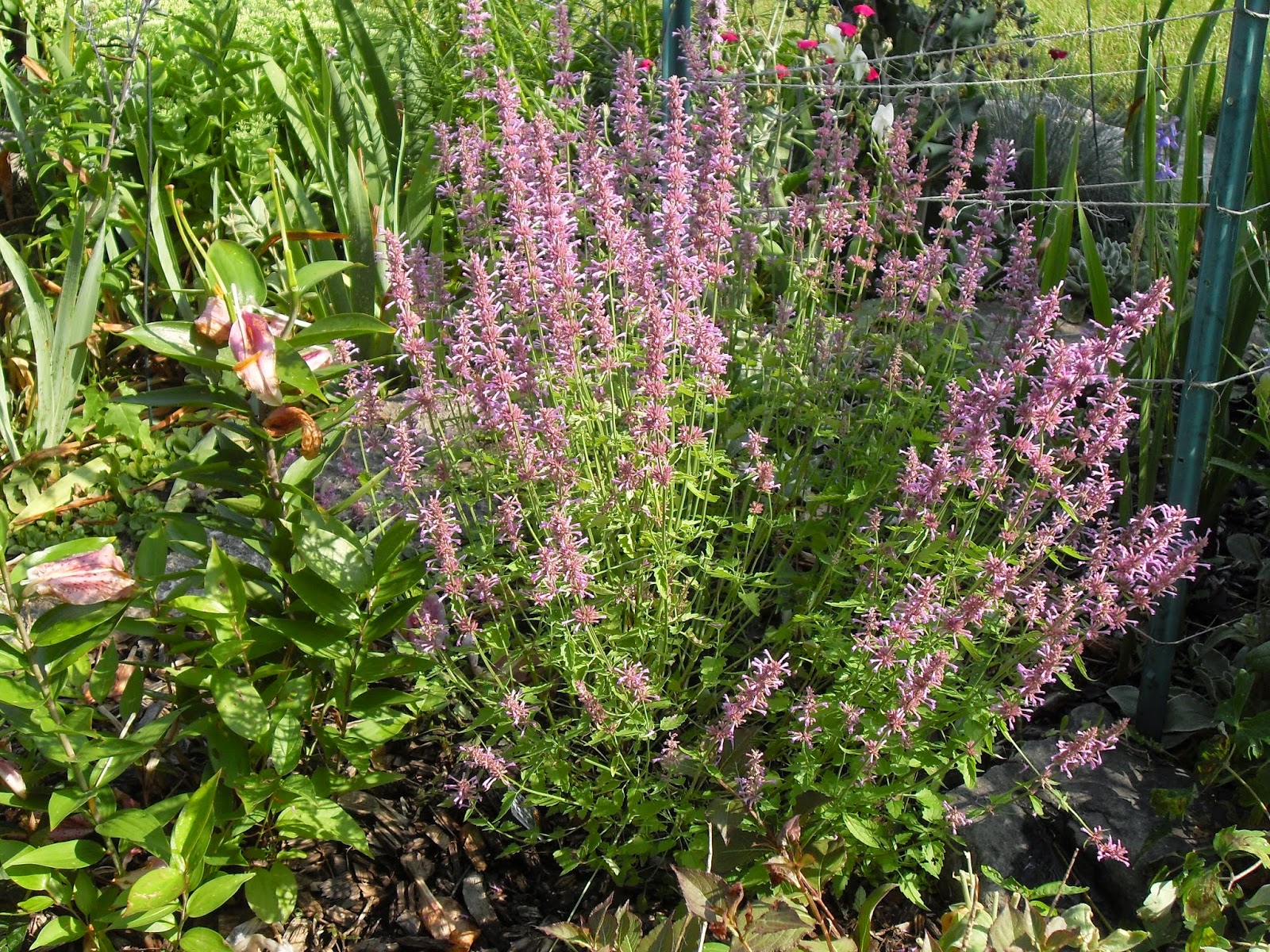
I can't resist putting in a few new perennials every year.  Some turn out to be duds, but this pink salvia was a winner.  It's fading now.  It's been blooming for about 6 weeks and it's quadrupled in size since it was planted.
Here's another favorite annual that comes back year after year.

Moss roses
These moss roses are growing in lime sand. I didn't plant them here.  They drifted over from the garden, where they hadn't done well.  

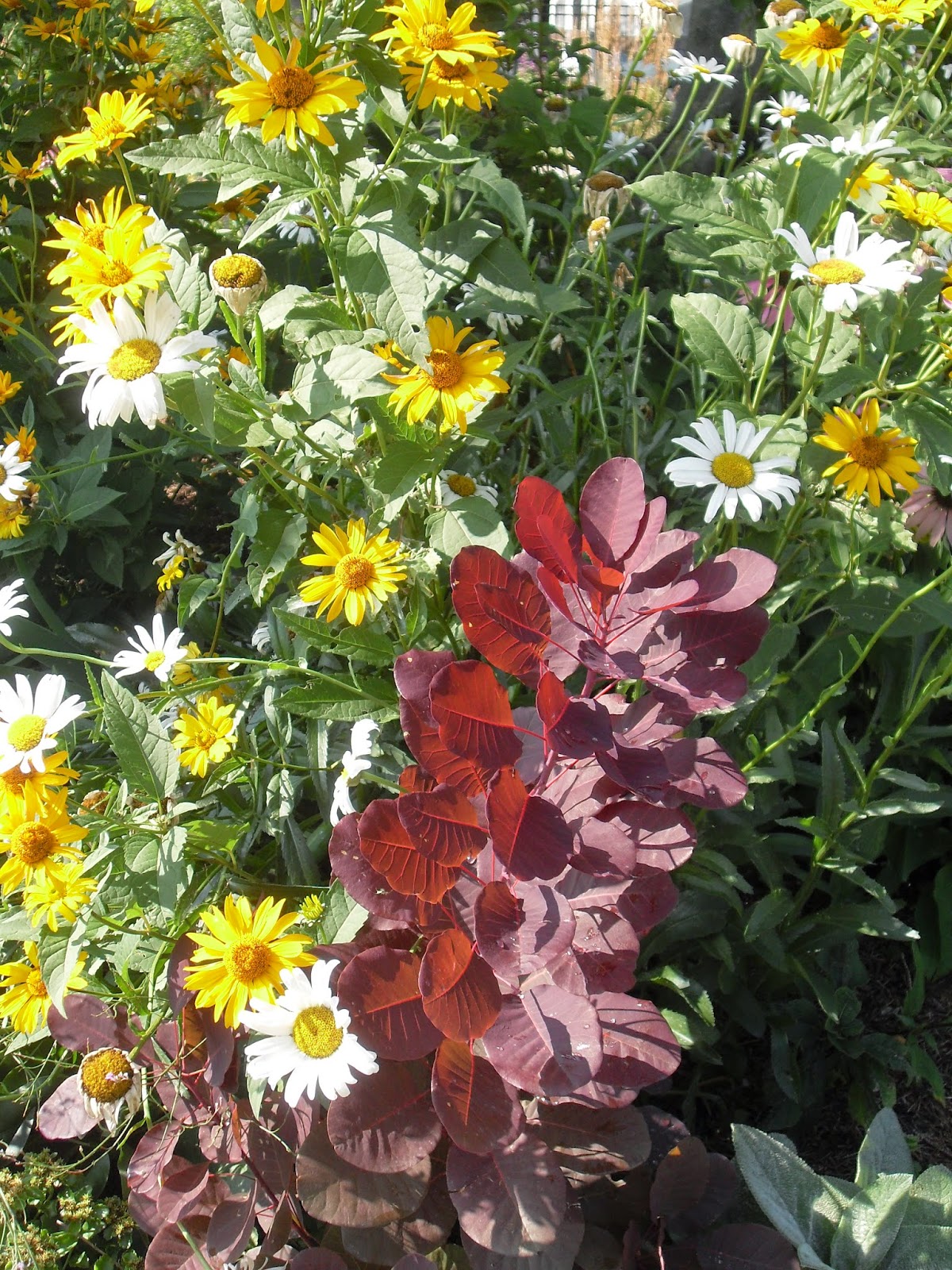
Even perennial gardeners have a few pots of annuals.  The plant in the foreground is something I've never seen before.  It looks like a flower, but it's all leaves.  I absolutely love it, but I didn't save the tag!  If anyone recognizes it, please help.  I would like to identify it so I can get it again next year.

Monday, August 4, 2014

Summer Transition

May, June and July have come and gone.  I was so busy working in gardens that I didn't have time to write about gardening.  Business has slowed enough now to allow me to get back to doing other things again.  I've even taken some time to work in my own sadly neglected garden. 

 Because I was in it so seldom this summer, the shift in blooms seemed dramatic.  One day there was iris all over. The next time I was free to enjoy a garden walk, iris was replaced by bee balm and daylilies. That's what I love about perennial gardens - the slow evolution of shapes and colors between spring and fall.

These are some of the things that were blooming in June.


Some of these plants were just starting in June and are still blooming - the catmint, blanket flower, and honeysuckle vine.  The peonies and orange poppies come and go so quickly, that you could miss them!

Here is what the garden had to show in July.


Speaking of plants that have a long bloom time, shrub roses are it!  I have pink, coral, orange, white, yellow, and red shrub roses.  They bloom all the way through fall.  Asiatic lilies, oriental lilies, yucca and daylilies are dramatic, but they won't be there for you all summer like shrub roses. Tomorrow I'll go out and see what's blooming in August.

Saturday, April 12, 2014

Spring Cleaning


Cleaning up the garden is not the most glamorous of gardening tasks.  There is the old perennial foliage to be pulled out, the layer of soggy leaves, and the shrubs that need to be pruned.  After the winter we've had, I'm so glad to be outside that even these mundane chores seem fun!  Especially since there are so many signs of life under all that debris.

perennial geraniums


             The mystery lilies are 4 inches tall already.

The first flowers of 2014!


If you haven't done the garden clean-up yet, you'll need to get out there very soon.  Tall grasses have to be cut down before fresh growth comes up through last year's dead stalks.  I found a way to make cutting down grasses easier.  I got a new toy - a soil knife.  It's turning out to be the most useful tool I own.  I used to cut down grasses with my electric trimmer.  It's easier with the serrated edge of the soil knife.  I wish I'd had this year's ago!


                                         Fresh growth is already up on these grasses.

Now is also the time to prune summer-blooming shrubs that bloom on new wood.  Spireas, mop-head hydrangeas, Russian sage, ninebark, and potentillas are in this category.

If it blooms in spring, don't prune until after flowering.

I love euonymus.  It needs no care and looks good all the time.  I took this picture today and it will look great until the snow covers it.  If only there were more plants like that!

Tuesday, March 25, 2014

Winter Burn


Now that the snow has finally retreated, I braved the 24-degree temperature (it only looked like a nice day) and walked around my yard for the first time in five months.  The good thing about a consistent, deep cover of snow is that it provides protection so that the perennials aren't exposed to sun, wind, and nibbling crittters.  The only plants that don't look so good are the Alberta spruce.  The south and west sides are brown and crispy.   I've noticed a lot of brown evergreen shrubs all over as I drive around.  Looks like this.


I've never seen winter burn to this extent, so I had to do a little research to find out if my Alberta spruce are going to be okay.  It turns out that if only the tips of the branches are brown, new growth may come in and mask the dead sections.  The brown parts are not going to green up though.  How you want to deal with your plant depends on the extent of the damage.  It might look better in a year or two, but certainly not this year.  If a branch is brown all the way to the trunk, it's dead and should be cut out.  If you only have to take out a couple of small branches, the surrounding ones might fill in the bare spots in time, but a shrub with gaping holes is never going to look good again.  Then it's time for some "shovel pruning". You might want to plant something else in that spot.  Alberta spruce are susceptible to winter burn and do best in a location that is sheltered from drying winter wind and sun. Yews grow back if you have to cut out damage and upright junipers are supposed to hold up well in harsh winter conditions.

I'm not sure if I'll have to take drastic measures with my Alberta spruce.  I'd hate to lose them after ten years.  But then I'd have the opportunity to try some other new plant, which is always fun!

Thursday, February 27, 2014

Getting Geraniums Shaped Up for Spring

Even though I am a perennial gardener, I do like zonal geraniums for their large flowers and non-stop blooming.  I use them in pots that I can move around to fill in bare spots in the garden where perennials have yet to bloom or have finished for the year, as well as in flower boxes.  Because I have ledge space in south-facing windows, I pot them up, cut them down, and bring them in for the winter.  They bloom on and off, which is a very welcome sight when it's below zero (again!).

Even with lots of light, the winter growth is leggy and weak.  It's time to prune them before their spring growth spurt.

This guy is healthy, but the recent growth isn't thick.
This guy bloomed all winter.  Now I want him to put his effort into producing strong stems.

Here's how to prune geraniums that you've overwintered to get fuller, more compact plants by summer.

Using a scissors reserved for gardening, make a cut directly above a leaf stem at a point where the main stem is strong and thick.  Cut all the main stems down this way.  You'll feel like you butchered your plant, but it's all for the best.

Keep cutting.

He looks a little sad now, but he'll be sending out new growth in no time.

When you're finished,  water and put your geranium in a sunny spot.  With the longer days, it's time to start fertilizing, too.   And don't be too eager to set geraniums out in spring.  They aren't happy with anything less than 50 degrees.  I've tried to push them outside too early and regretted it.