Showing posts with label Wisconsin gardening. Show all posts

Sunday, January 11, 2015

The winter garden

It always makes me a little sad when all the outdoor Christmas lights are put away for the year.  The yard seems bare and plain.  It was sunny and warmer today (above zero!) so I took a walk around the yard and realized that it's full of interesting sights.  Not the bling of Christmas lights, but still beautiful.  Of course it is - I planned it that way!


We in Wisconsin only have five or six months to spend out in our yards.  The rest of the year, the garden can still be enjoyed from the window.  It takes some of the dreariness out of winter days to look out and see something besides solid white. But it takes some planning when it's warm to set your landscape up with winter interest.  This spring, in addition to picking out new plants to try and arranging pots on the deck, think about what you'd like to see out your windows in winter 2016.  Here are some things you might want add to your landscape so that next winter you'll enjoy your yard for all 12 months.

Garden art is instant color and form.  Gazing balls come in so many gorgeous colors.  I want them all!  Bottle trees add a pop of cheerful color.  Unpainted metal sculptures are a more subtle focal point.
This is a driftwood "sculpture".
Sturdy vines like this trumpet vine have a sculptural form in winter.

This crane gets lost amid the summer foliage.  I forget he's there until winter.

A sundial makes an interesting focal point.

Cement scupltures hold up well in our harsh weather.


Not all grasses are hardy in our winters.  Check before you buy.
There are lots of  landscape plants you can enjoy year-round.  If you don't have any hardy tall grasses in your garden, you need some! Plant them in the front yard where you'll see them waving in the wind every time you leave your house or come home.


River birches look great in winter.  The peeling bark is more apparent when the leaves have fallen.


When you're cleaning up your garden in fall, leave some sturdy perennials standing. 


The flower heads of coneflower and hydrangeas will look good until spring.


If you want to see something green in winter (besides conifers) plant holly or yucca.


For some color, yellow and redtwig dogwoods stand out in the snow.


For subtle winter beauty, add some rock to your garden.  I love how the snow drapes over our rock retaining walls.


I didn't notice that I forgot to bring this little guy inside for the winter until I wondered what that thing was sticking out of the snow.  He's going to be upset!


Friday, November 7, 2014

One Last Garden Chore

By now all the garden clean-up is done. The leaves are hopefully chopped and put in your compost pile or left on the grass and gardens.  The produce has all been eaten or preserved. Fall always makes me a little sad.  The bright colors of the garden have turned to browns and golds.  I took a walk around the garden yesterday and was surprised that there are still some beautiful sights.

Cheyenne privet is a wonderful shrub.  It grows quickly into a privacy hedge, takes well to shearing, and gets these dark blue berries in fall.

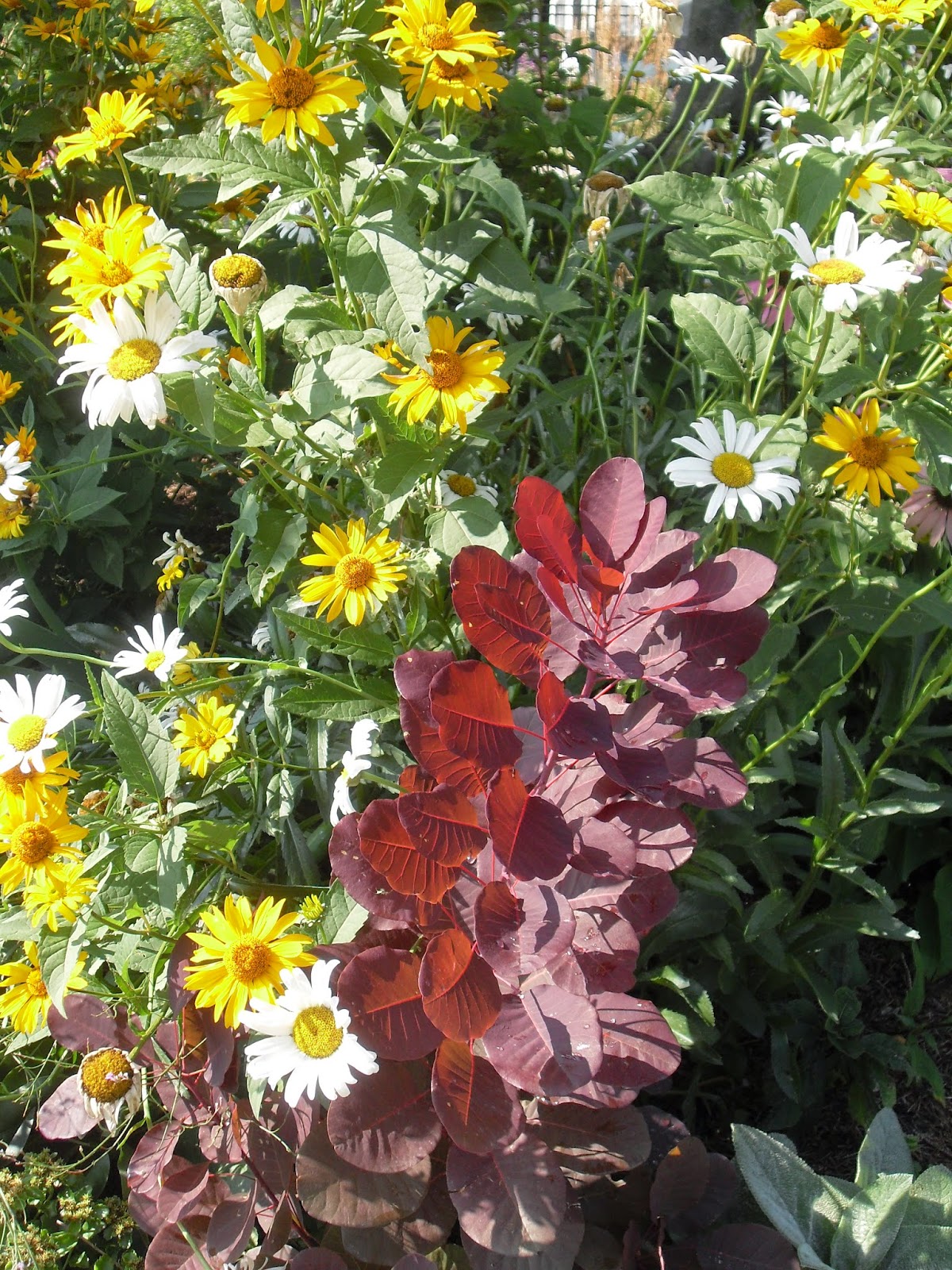
Smokebush is one of my favorite shrubs for color all the time, especially in fall.

The lavender was still blooming last week, and it still smells wonderful.

Snapdragons keep blooming even though we've had frost several times.


Before you say goodbye to your garden, there's one more thing you might want to do.  Remember last winter?  Our gardening business was busy in spring taking out dead Alberta spruce and yews.  We have plenty of both in our yard.  We plan on providing protection this winter. We didn't lose any shrubs, but we have some topiaries that had winter kill in spots and didn't recover.  The deer have also done a lot of damage to our arborvitaes in the past.

This arborvitae was a yummy deer snack.

Last year we wrapped the arborvitaes with plastic mesh and the deer were foiled.  In addition to that, we're going to wrap the Alberta spruce and yews with burlap.  It's a pain, but not even close to the work of digging out dead shrubs, not to mention the expense of buying new ones.  It's also important to give evergreens a good soak before the ground freezes.  They continue to lose moisture through their needles all winter.  The extra effort might be worthwhile when you consider the investment you have in your landscape.

Tuesday, September 16, 2014

Prolific little pumpkins

I'm not a big fan of fall.  It's always a little depressing to see it get cool and dark earlier each evening. But there are some things I like about fall, and pumpkins are one of them (and pumpkin pie, pumpkin bars, pumpkin bread, etc.).  The mini pumpkins I talked about yesterday were harvested today - 87 from four plants.  One plant, the white Gooligans, produced 41 pumpkins!  Of course, my favorite variety of the three I planted, the orange and white striped Hooligans, produced only six pumpkins. The other two plants were the orange ones, 20 pumpkins per plant.

I'll be planting these again next year for sure, but NOT in the fenced-in vegetable bed. (See yesterday's warning about sprawling garden bullies.) I have a big, sturdy trellis where a clematis died last winter.  I'll try mini pumpkins on it next year.

If you like decorating with gourds and pumpkins, I highly recommend growing them instead of buying.  They require no care beyond planting a seed and watering daily until it sprouts.  For the price of a pack of seeds, you'll have all the gourds or pumpkins you could possibly use and plenty to share with your neighbors.

Monday, September 15, 2014

One last harvest

There isn't much left to harvest from the vegetable garden.  The tomatoes, peppers, and beans are about done.  Carrots and kohlrabis are still going.  But there is one thing I've been waiting for and I think I'll harvest them this week - mini pumpkins!


These are actually edible pumpkins, not the gourds that look like mini pumpkins.  They're about 3"x 2".  


All three of these varieties came in one package called Harvest Blend.  The varieties are Bumpkin (orange), Gooligan (white), and Hooligan (orange & white mottled).  I just got the seed package out and read the back again.  I hadn't read it carefully when I planted, so I missed the line that says that these can sprawl just as far as larger varieties.  Oops!  That explains why they went over the fence, across the path, and into the lawn.  That will teach me to read seed packages more carefully.  I will definitely plant these again next year, but not in the vegetable garden.  They sprawled over the carrots and basil, blocking out the sun.  They were garden bullies and will not be allowed back into the playground next year. They probably don't need to be in the fenced-in area.  The back of the flower garden is a good spot for them.  They can have all the room they want.  I don't think deer or rabbits would be interested in them.  I saw a front yard garden yesterday that included full-sized pumpkins growing among the flowers.  What a great idea!  It was really eye-catching.  In a cottage-style garden they could wander wherever they want to.  I'll be trying that next year.  

It's raining today, so I'll have to wait to harvest them.  When I do, I'll report back on how many pumpkins I got from my four plants. 


Tuesday, August 12, 2014

Rain in My Barrel

It rained for a little while yesterday.  Not really enough to give the garden a good soak, but enough to fill my rain barrel.  Going to the rain barrel with my watering can and finding it empty is such a disappointment. There's something about rainwater.  When things are really dry, you can keep them alive by watering with the hose, but one good rain, and everything springs right back.  It's like nature adds a secret ingredient!  That's why I much prefer to water my vegetables, window boxes, and pots from the rain barrel when I can.


I have my rain barrel located just a few feet from the vegetable garden to make it really convenient.  There is a spigot, but I'm too impatient to fill the watering can that way.  I usually just remove the lid and dip the can in the barrel.


It's surprising how little rain it takes to fill the barrel.  I've only used the hose to water a couple of times all summer. I'm thinking of adding a second one on the other side of the house.  Maybe that will eliminate the disappointment of finding an empty rain barrel.

It just started raining as I'm writing this.  My empty barrel will be full again. Yea!

Tuesday, August 5, 2014

Miss a day, you miss a lot

When I was a teacher, there was a poster in school that said something like, "Miss a day, you miss a lot."  A perennial garden is kind of like that.  You go on vacation, and it's changed when you get back.  Every time we return from one of our camping trips, we walk around the gardens to see what's new.   Yesterday I posted pictures of plants that were blooming in June and July.  I walked around with my camera today to see what's new for August.


Morning glories


Snapdragons are one of my favorite flowers.  Although they are an annual, they seem like a perennial because they reseed so reliably.  I bought a flat many years ago and I have had them in my yard ever since.  Of course I can't say where they'll show up. Gardener's surprise!

Snapdragons come in lots of  different colors.


Sea holly
Sea holly is another favorite.  It also reseeds.  The stems are the same blueish-purple as the flower!

Balloon flower


Balloon flower is also a favorite (I guess they're ALL my favorite!)  Before the blooms open, they look like tiny balloons.


Most daylilies are finishing up, but there are late varieties that are just getting going.

Trumpet vine


Mallow (zebrina)
Potentilla
Astilbe
There two have been blooming for a long time - my kind of plants!

Okay, so it's not new in August, but the coneflower still looks great!

I can't resist putting in a few new perennials every year.  Some turn out to be duds, but this pink salvia was a winner.  It's fading now.  It's been blooming for about 6 weeks and it's quadrupled in size since it was planted.
Here's another favorite annual that comes back year after year.

Moss roses
These moss roses are growing in lime sand. I didn't plant them here.  They drifted over from the garden, where they hadn't done well.  

Even perennial gardeners have a few pots of annuals.  The plant in the foreground is something I've never seen before.  It looks like a flower, but it's all leaves.  I absolutely love it, but I didn't save the tag!  If anyone recognizes it, please help.  I would like to identify it so I can get it again next year.

Monday, August 4, 2014

Summer Transition

May, June and July have come and gone.  I was so busy working in gardens that I didn't have time to write about gardening.  Business has slowed enough now to allow me to get back to doing other things again.  I've even taken some time to work in my own sadly neglected garden. 

 Because I was in it so seldom this summer, the shift in blooms seemed dramatic.  One day there was iris all over. The next time I was free to enjoy a garden walk, iris was replaced by bee balm and daylilies. That's what I love about perennial gardens - the slow evolution of shapes and colors between spring and fall.

These are some of the things that were blooming in June.


Some of these plants were just starting in June and are still blooming - the catmint, blanket flower, and honeysuckle vine.  The peonies and orange poppies come and go so quickly, that you could miss them!

Here is what the garden had to show in July.


Speaking of plants that have a long bloom time, shrub roses are it!  I have pink, coral, orange, white, yellow, and red shrub roses.  They bloom all the way through fall.  Asiatic lilies, oriental lilies, yucca and daylilies are dramatic, but they won't be there for you all summer like shrub roses. Tomorrow I'll go out and see what's blooming in August.